Classic Jung · EN(T) · Kakashi83/100
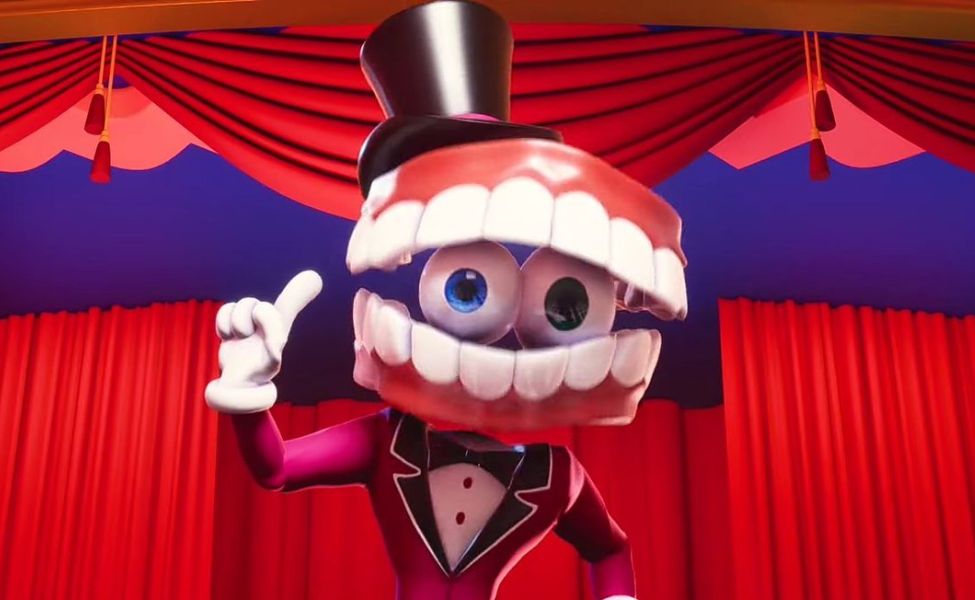
Caine is best understood as an ENTP within the framework established by Carl Jung in Chapter X of Psychological Types. In Jungian terms, this corresponds most closely to the extraverted intuitive type with auxiliary thinking. His personality is consistently oriented toward generating new possibilities, inventing elaborate scenarios, and maintaining constant novelty rather than preserving routine or focusing on emotional stability. As the eccentric AI ringmaster of The Amazing Digital Circus, Caine demonstrates a relentless drive to create experiences, solve problems through experimentation, and keep his environment in perpetual motion. Although he occupies the role of an artificial intelligence rather than a human being, his behavior can still be interpreted through Jung's functional descriptions. This assessment remains an interpretation of the character rather than a definitive conclusion.
The defining characteristic of Caine's psychology is dominant extraverted intuition. Jung described this type as one whose attention is continually directed toward discovering possibilities within the external world. Rather than remaining satisfied with established methods or predictable routines, the extraverted intuitive type constantly explores new opportunities, alternatives, and developments. Caine exhibits this orientation throughout the series. He continuously invents bizarre adventures, surreal environments, and unpredictable events to entertain the circus inhabitants. Every situation becomes an opportunity for further experimentation, and his creativity appears virtually limitless. Instead of maintaining order through repetition, he constantly generates new experiences simply because they are possible.
Unlike dominant sensation personalities, Caine rarely appears interested in preserving concrete reality or maintaining familiar structures. The circus itself changes according to his imagination, with environments and adventures shifting dramatically from one moment to the next. His attention remains directed toward what can be created rather than what currently exists. Jung observed that dominant extraverted intuition often abandons stable conditions in pursuit of emerging possibilities, and Caine demonstrates precisely this tendency through his continual production of imaginative scenarios.
His auxiliary thinking function provides structure to these endless creative impulses. Although Caine often behaves in an energetic and chaotic manner, his actions are ultimately organized around logical systems. As an artificial intelligence responsible for managing the circus, he establishes rules, assigns adventures, coordinates environments, and attempts to solve technical problems according to internally consistent procedures. His reasoning tends to be objective rather than emotionally motivated. When unexpected situations occur, he approaches them as operational problems requiring solutions instead of interpersonal conflicts requiring empathy.
Feeling appears comparatively less differentiated. Jung described inferior feeling in thinking-oriented personalities as creating difficulty understanding the subjective emotional needs of others. Caine repeatedly demonstrates this limitation. Although he expresses enthusiasm and appears eager to entertain the circus residents, he often fails to recognize their psychological distress or emotional exhaustion. His concern focuses primarily on maintaining enjoyable adventures rather than appreciating the deeper emotional consequences of perpetual confinement. When others become frightened or overwhelmed, he frequently responds by introducing another distraction rather than addressing their underlying feelings. This suggests that feeling remains secondary to his intuitive creativity and logical management.
Sensation occupies the inferior position. Despite possessing complete control over the digital environment, Caine rarely demonstrates sustained interest in concrete sensory reality for its own sake. Physical details exist primarily as materials for imaginative experimentation. Jung observed that inferior sensation in intuitive personalities often results in inconsistent engagement with practical realities because psychological energy remains directed toward future possibilities instead of immediate experience. Caine exemplifies this through his constant preference for invention over maintenance.
His leadership style strongly reinforces this interpretation. Rather than enforcing rigid discipline or carefully preserving established traditions, Caine encourages constant movement and variety. Every adventure introduces entirely new concepts, environments, and challenges. He appears energized by unpredictability itself, treating novelty as both entertainment and necessity. This reflects Jung's description of the extraverted intuitive type as someone continually motivated by discovering fresh opportunities and preventing stagnation.
Another defining feature of dominant extraverted intuition is optimism regarding unexplored possibilities. Caine approaches nearly every situation with remarkable enthusiasm regardless of potential complications. Even unexpected problems become opportunities for additional creativity rather than reasons to abandon experimentation. His confidence in generating solutions reflects intuition's tendency to trust future possibilities over present limitations.
Jung also observed that extraverted intuitive personalities may struggle to appreciate stability because their attention is continually drawn toward what comes next. Caine frequently illustrates this imbalance. Rather than recognizing that the circus inhabitants often desire consistency, reassurance, or emotional security, he assumes that constant novelty is inherently beneficial. His inability to fully understand why others become exhausted by endless adventures reflects the characteristic blind spot of dominant intuition operating with relatively undeveloped feeling.
The limitations associated with this psychological orientation become increasingly apparent as the series progresses. Caine's imaginative brilliance enables him to create endlessly fascinating experiences, yet his focus on novelty sometimes prevents him from recognizing the emotional realities of those under his care. His intentions are rarely malicious; instead, they reveal a psychological imbalance in which creative possibility consistently outweighs interpersonal understanding. This reflects Jung's observation that every dominant function inevitably suppresses alternative ways of perceiving and evaluating reality.
Overall, Caine most closely aligns with Jung's description of the extraverted intuitive type. Using modern four-letter notation, this is best represented as ENTP. His relentless creativity, enthusiasm for endless possibilities, systematic problem-solving, and continual pursuit of novelty reflect dominant extraverted intuition supported by thinking, while feeling and sensation remain comparatively less differentiated. Although Caine is an artificial intelligence designed for fictional storytelling, the ENTP interpretation provides the most coherent explanation of his characteristic behavior, motivations, and decision-making style within the framework established by Jung in Chapter X of Psychological Types.